6 Lessons on the Future of the Metaverse From the Creator of Second Life

Written By

Second Life
 
Second Life

A screenshot from the virtual reality world “Second Life.” Credit – Courtesy Linden Lab

A version of this article was published in TIME’s newsletter Into the Metaverse. Subscribe for a weekly guide to the future of the Internet.

In 2007, Second Life founder Philip Rosedale made a bold proclamation: “The 3D web will rapidly be the dominant thing and everyone will have an avatar.” Considering the success of his creation, it wasn’t an altogether far-fetched idea. Second Life—a virtual world in which participants can explore fantastical landscapes and build their own mansions, forests and spaceships—was reaching the crest of its popularity, with hundreds of thousands of active residents and a self-reported $500 million in GDP. Second Life appeared on the cover of BusinessWeek; presidential hopeful and Virginia Gov. Mark Warner gave a town hall, with his avatar sporting a blocky suit and red tie. Brands like Reebok and Dell invested in virtual stores, preparing for a new era of sales and marketing. Rolling Stone referred to it (skeptically) as “the future of the net;” The Guardian proclaimed: “Today Second Life, tomorrow the world.”

Does any of this sound familiar? It’s hard not to look back on the frenzy around Second Life in the mid-aughts and see parallels to the discourse around the metaverse these days. Rosedale and other Second Life optimists often used identical rhetoric to crypto idioms today: He called Second Life “the Wild West,” compared its growth to that of the early internet and foresaw the “entire physical world as being kind of left behind.”

And then Second Life stopped growing. It wasn’t uncommon for users to struggle for hours on-boarding into the world, only to find themselves wandering around ghost cities with empty storefronts. Reuters—which made a big fuss of opening a bureau in Second Life in 2006—pulled out about two years later; brands abandoned their posts. As we look back on Second Life a dozen years after its peak, it’s less a transformative cultural lynchpin than the punchline of a scene in The Office.

On the other hand, it would also be a gross misrepresentation to view Second Life as a failure. It was responsible for introducing millions of people into virtual spaces for the first time; for fostering incredibly tight-knit communities, especially for outcasts or physically impaired people; and for pioneering digital economies. A spokesperson for Second Life’s parent company Linden Lab said that users have spent the equivalent of 500,000 years in Second Life, and that 750,000 monthly active users still inhabit the world: flying around, building and buying stuff, nurturing virtual families.

So there’s plenty that the current builders of the metaverse can learn from Second Life, both for better and worse. To look back—and forward—I talked to Second Life founder Philip Rosedale and Tom Boellstorff, an anthropologist who spent two years inside the virtual world at its peak and then wrote the book Coming of Age in Second Life: An Anthropologist Explores the Virtually Human.

Here are some of their main takeaways from the Second Life saga.

People will stay in virtual worlds, even without an explicit mission.

As Dwight Schrute tells Jim Halpert on The Office, Second Life is not a game: “It doesn’t have points or scores; it doesn’t have winners or losers.” It is this aimlessness that confounded many early users, and a similar criticism continues to dog recent conceptions of the metaverse. What is the “killer app?”—the feature that makes it indispensable to users—critics ask. What is the point of a world that doesn’t fulfill an obvious need?

But Boellstorff and Rosedale say that this potential flaw is actually an essential reason that many people stuck around in Second Life. “It’s often not that going into a virtual world is sort of fulfilling a pre-existing need,” Boellstorff says. “A lot of people check these things out because they hear about them, but then sort of discover something that they enjoy doing or a community they enjoy interacting with that they didn’t know about ahead of time.”

Rosedale says this unbounded potential for creation was a key reason for Second Life’s success. “I think the reason why tens of millions of people tried it out was the promise of the ability to be creative and expressive in a realistic, lifelike domain,” Rosedale says. “You need a toolkit that lets people build things live from kind of small parts: That has to be present in a metaverse to make it successful.”

People will spend money on digital goods—but very few creators will actually make a living.

Another common talking point against the metaverse is that people won’t buy things that only exist in virtual spaces. Second Life emphatically proved this false: In the 10 years following its launch, Second Life users spent $3.2 billion of real money on in‑world transactions. Rosedale likes to say that Second Life contained the first NFTs: unique virtual goods that you could buy and sell. A dress designer could create a unique dress for a virtual ball, for example, so that its wearer would stand apart from their peers.

Rosedale says there was a key distinction between Second Life’s one-of-one goods and NFTs, however: Speculative value wasn’t at all a factor in Second Life. “I’m very proud of the idea that there is an intrinsic value—for a coat for your avatar or a motorcycle—that’s driven by the creativity of the designers,” he says.

These unique digital items made up a very small percentage of Second Life’s overall economy, and only a scant few made a living off creating them. Boellstorff is skeptical of recent utopian digital visions in which most independent creators are able to thrive through selling digital goods. “It’s similar to something like YouTube: You have a relatively small percentage who really make income from it, and a lot of people who are just consumers, or some people who sort of informally make stuff that they don’t sell to make money,” he says.

Ease of use and technological challenges remain a huge roadblock for mass adoption.

In a 2017 article about Second Life, the Atlantic reported an estimated 20% to 30% of first-time users never returned to the platform. Many found the world extremely difficult to figure out. Reuters ​​reporter Eric Krangel wrote that the Second Life had a “monster learning curve,” a convoluted user interface and an oft-crashing server. The company also struggled to build a viable mobile version during an era in which smart cell phones were becoming ubiquitous.

While Second Life itself has resolved many of those issues thanks to technological advancements, any virtual world hoping to win over a mass audience still has to overcome huge barriers to entry. Rosedale says that his current company, High Fidelity—which specializes in spatial audio for apps like Clubhouse—ran recent studies on metaverse technology, and found that “people don’t want to be a cartoon avatar while wearing a VR headset,” he says. “We concluded it was an extraordinarily difficult thing to get, like, regular people at work to want to become a cartoon avatar with very little in the way of facial expressions. It’s really stressful for people to do that, and most of them won’t.”

(Meta, Facebook’s parent company, is investing heavily in creating photorealistic avatars; Microsoft’s avatars remain cartoons.)

Virtual worlds might always struggle to appeal to certain demographics.

Rosedale notes that the current interest in the metaverse arose from of a singularly strange moment of the pandemic in which everyone was trapped inside their homes. He says it’s much harder to get certain people excited about spending the bulk of their time in virtual worlds in normal circumstances.

“If you live a comfortable life in New York City and you’re young and healthy, you probably are going to choose to live there. If I offer you the life of an avatar, you’re just not going to use it very much,” Rosedale says. “On the other hand, if you live in a rural location with very little social contact, are disabled or live in an authoritarian environment where you don’t feel free to speak, then your avatar can become your primary identity.

Identity is tricky, and so is rule-making.

While Rosedale had the unilateral ability to shape the world of Second Life as he saw fit, he tried to be as hands-off as possible, adhering to principles of decentralization. This led to some amount of nefarious activity: reports of underage sex simulation, money laundering, and copyright and trademark violations.

“The question of what kinds of moderation is needed for us to equitably co-exist in a metaverse are yet unanswered,” Rosedale says. “There are things like getting identity right, so you’re not doxxing a person by identifying the real person behind the avatar—but the avatar or the pseudonym of the individual is sufficiently stable so there are consequences to their actions and they’re going to behave well. But we are simply not there yet on the internet: We don’t have identity systems yet that would enable strong governance.”

Boelstorff believes that Second Life’s subscription model—in which people pay to own land—has helped ward off the worst tendencies of ad-driven companies like Facebook, which was shown to have prioritized profit over tamping down on misinformation. (The tech pioneer Jaron Lanier also has argued that many problems would be fixed if Facebook and Twitter switched to a paid model.) “The subscription model of Second Life is one reason that you don’t have misinformation and anti-vax stuff,” Boellstorff says. “None of this metaverse stuff going forward has to be a particular corporate ad-driven model.”

The metaverse doesn’t need to be ubiquitous. In fact, it shouldn’t be.

When asked why Second Life failed to keep growing, Boelstorff bristled at the question. “This hype of the Silicon Valley capitalist model is so overwhelming in the sense that to attract venture capital, you have to really sell yourself as the next iPhone or the next Facebook—that you’re going to transform the entire world,” Boelstorff says. “I think it just has such a warping effect in terms of agenda setting. There’s potentially some really good stuff about being online more and more, especially for folks who are disabled, or for climate change in reducing cars on the road. But I never shade into this like, ‘We’re all going to be living in the Matrix’ kind of thing.’”

More than a decade after Second Life’s peak, Rosedale concedes that he conceptualizes our move into virtual worlds with less inevitability than he did in 2007. But he says Second Life shows that there’s still a huge appetite for virtual exploration, especially as the technology improves. “Allowing somebody to be really expressive and creative in an environment that’s lifelike is an incredibly powerful offering. I think that’s why we all tried Second Life,” he says. “And I think that we will eventually get there—but it’s still a long road because the difficulty of it is considerable.

Have A Great Week From All Of Us At Zoha Islands And Fruit Islands.

Second Life Spotlight – Sirux Mahoney

Today we are shining a spotlight on Sirux Mahoney, the CEO of FANTASYLAND Estate since 2006 who is now venturing into an impressive NFT/Second Life crossover project called Universe v2.

Sirux.pngHow long have you been in Second Life and how did you first hear about it?

I have been in Second Life since 2006. Prior to that, I was in another 3D world and became quite popular, so much that I became its official partner for my region. My community kept on growing over the months and then one night, one of my good friends, who went missing for some days, reappeared and told us that she had been spending time in Second Life. She had lots of praise for Second Life and insisted that we should all try it out. While many of my community members felt enthusiastic about the idea, I was rather skeptical, though I have to admit that I Googled it to find out more. My concern was about leaving everything behind, especially my good friends, going back to square one in another world. I could see my community crumbling. I decided to stick around and watch how things developed. And things did develop. The inevitable happened. I witnessed an exodus of my community members to Second Life. And when my good friends started moving too, I realised that my initial concern was no longer valid. I entertained mixed thoughts in my mind over the next couple of days and then one day, as I was driving back home, I decided to take the plunge! The next thing I remember I was creating my account on Second Life and logging in to discover what the hype was all about. The rest is history. I found my way on Second Life and made it even bigger than in that other 3D world. I never went back!

You are already well known for FANTASYLAND Estate, a virtual real estate provider in Second Life and you have been very active in this market since 2006. What got you interested in it? Tell us more about your business and how you got started in virtual real estate.

When I joined Second Life and connected again with my friends from the other 3D world, where we mostly spent time chatting, we found out that Second Life had so much more to offer. Instead of just meeting up and chatting, we started to explore, visit places, shop around and get engaged in various activities all over Second Life. We quickly noticed the business potential of Second Life and while some of my friends became designers, builders, and scripters among other things, I decided to try my luck at the real estate business as the common thing we all spent money on was land! That’s how FANTASYLAND Estate was born. I was lucky that my business jump-started as all my friends started to rent from me and kept on recommending their friends. The orders came pouring in and FANTASYLAND Estate kept on expanding to become what it is today, thanks to the dedication and customer care shown by our team over those 15 years. I take this opportunity to thank all my staff members, and all my tenants for trusting us and making us what we are today. And last but not least, all the wonderful people at Linden Research, Inc., for working with me and providing me with the support needed.

Fantasyland Estate.jpg

Outside of your real estate endeavors, what are some of your favorite things to do or places to visit in Second Life?

Honestly, I would love to find more time out of my busy schedule to be able to enjoy what Second Life has to offer. When I do have some free time though, which happens very rarely, I log on to an anonymous account to meet up with friends and go around freely and unnoticed! Apart from my real estate business, I have been actively involved for a long period of time with breeding horses on Second Life. Actually, I still have a large collection and do it from time to time. I love horses, and I am fascinated by the uncertainty and reasoning involved in the breeding mechanics.

banner.png

We hear that you have a brand new project debuting this week — Universe v2 – Rise of the Robots. This appears to be an NFT project that has a unique Second Life component. Can you explain a bit about this project, which I understand has an elaborate backstory about the robots. Can you tell us a bit about the story – and how will this work for people who want to check it out and potentially participate?

Oh yeah I love the storyline of our new project, Universe v2:

‘The Law of Conservation of Mass states that matter can neither be created nor destroyed, although it may be rearranged in space and the entities associated with it may be changed in form.

End of 2021. This is what actually happened. During a cataclysm, the universe got rearranged. The sun remained but the planets {that we know} disappeared, and two new planets were formed: Onerion and Zerotia. But what happened to the living entities? Well, they changed in form! Onerion and Zerotia are inhabited by different colonies of robots, each one having unique characteristics that are passed on through fusion. Onerion and Zerotia move along different elliptical orbits around the sun and every three months, they concurrently become aligned with the sun causing a cosmic tunnel to open up in space, linking the two planets. What happens next? Well, some things never change: Onerions and Zerotians travel along the tunnel, waging war against each other in the New Universe. Universe v2, Rise of the Robots.’

The ‘Universe v2’ NFT collection consists of 9,998 robots (4,999 Onerions and 4,999 Zerotians) minted on the Solana network, each robot with a unique combination of attributes. We are launching our whitelist registration on 4th Dec at 12.00pm UTC, limited to 1,500 slots with max 4 NFTs per slot, which gives registrants access to our PreSale Round 1 mint at only SOL1.35 (roughly USD285). Presale Round 1 mint will start once all whitelist slots are taken, followed by PreSale Round 2 mint, limited to 3,000 NFTs at SOL1.35 still. The last minting stage will be Public Minting at SOL2.50. The Second Life component of the project is that we are giving away the corresponding 3D Models of the NFTs on Second Life to those who mint during PreSale.

As with any NFT project, early minting is crucial. If you are new to the NFT world, basically early minting an NFT is similar to you buying at wholesale, getting the distribution rights to a product direct from the ‘manufacturer’ and then deciding to keep it, use it or even onsell it at a higher price. I would therefore recommend anyone interested to book a whitelist spot on our website as soon as registration opens on 4th Dec. For the records, we have seen NFTs getting resold at USD $170,000 just one month later while the minting price was less than USD $20.

While full information, including the Road Map and FAQ, about the Universe v2 project is available on our website, it is indispensable to anyone interested to join our Discord server as this is where we actually keep in touch with all our members, providing regular and important updates.

video-clip-robot-1.png
Second Life 3D Model

Is this your first NFT project? What made you interested in entering into this space?

Yes, this is my maiden NFT project. What got me interested in the first place was the hype. However, since the beginning, I felt that there was something just not right about them. I didn’t like the idea of people buying an NFT to keep as a collection piece or immediately reselling it for a profit. I wanted to make something different. And that’s what the Universe v2 NFT collection is all about! A Universe v2 NFT is not just an NFT which you keep or try to onsell for a profit straightaway. It is a living piece of technology which you can use for your enjoyment while even earning rewards, which also evolves, making its worth soar for you to show off or eventually onsell for an unbelievable profit! Our road map has it all planned out to make this happen. We have invested a lot in this project and have big hopes. For these to come to fruition, we rely on our community to trust us as we work together to make this project enjoyable and rewarding all along for everyone, and achieve its full potential. We plan to build a Universe v2 Legacy, together with our members!

video-clip-robot-2.png
Second Life 3D Model

While this sounds really cool, we know that not everybody may be a fan of NFTs — and/or there may be some hesitation or confusion about them. Can people participate in Second Life without the NFTs – or is that something you are considering for the future?

Indeed you are right. While the NFT market is very promising, it is a niche market and fairly new too. On top of that, we have a limited number of 9,998 NFTs which means that they won’t be available for everyone. The limited supply is actually an intrinsic feature of any NFT collection, contributing to make the floor price of the collection soar above the original release price (the minting price) and actually reach astronomical values in some cases, as I pointed out earlier. With that in mind, we understand that some people, without the NFTs, would love to have one of our robots and participate in our MMORPG further down our road map. We shall definitely give it due consideration and look into ways of properly integrating new components in the future, making the project progress further. This is perfectly in line with the last point mentioned in the road map on our website.

pic1.png
Universe v2 NFT Robot (left) – Second Life 3D Model (right)

It seems like this has the potential to introduce Second Life to entirely new audiences. How are you planning to help connect your new NFT consumers directly to Second Life — and potentially explore more of the virtual world beyond claiming their robots?

Yes, we could be among the first, if not the first, projects to be giving away corresponding 3D models of the NFTs right off the bat! Since my team is actively involved in Second Life on a daily basis, it provides us with the ideal platform to do that. Our 3D Artist team did an awesome job delivering the quality we aspire for. We understood from the beginning that this endeavour would entail getting Second Life introduced to new audiences and we got our team prepared for that. We have a link on our website for our community members to register for a Second Life account and log on to visit us on the Universe v2 region, where they can see the 3D robots being made and even meet and greet them! We know this experience can be a bit tricky for first-time users. We have a specific channel on our Discord server dedicated to providing the initial help to our members regarding registration and logging on for the first time. And once in-world, we have our team to guide them and cater for their orientation. We believe this process will become easier once we have Second Life Residents join us in this project, make new friends in the community and contribute towards helping them not only with the Universe v2 project on Second Life, but also with discovering the immense outreach of Second Life.

pic3.png
Universe v2 NFT Robot (left) – Second Life 3D Model (right)

This is all pretty exciting — are there other new projects that can we expect from you in the future, too?

We do have two more projects planned. The first one, which is actually already in the works, is related to the NFT metaverse though it won’t be an NFT collection as such. The second is the development of a mobile app which will link people worldwide and make it much easier for them to communicate and cooperate while playing a popular augmented reality (AR) mobile game, thus allowing them to progress faster in the game.

Where can people learn more about your work? Please share links to your sites and social media accounts.

While our website provides all information about Universe v2, our Discord server is where we actually make important announcements, provide regular updates, hold discussions, answer questions and work together with our community members towards our common goal. We would say it is indispensable to anyone interested in the project to join our Discord.

Website: https://universev2.com 
Discord: https://discord.gg/universev2 
Twitter: https://twitter.com/Universe_v2 
Flickr: https://www.flickr.com/people/universev2 
Youtube: https://www.youtube.com/channel/UCGhxlI0SLzIiACgbLzUqGxQ 


View the Universe v2 Official Trailer, shot in Second Life, video production by Vrutega.


We hope you enjoyed learning more about Sirux and his impressive new project. Each of these weekly Spotlight posts will feature a different Resident to showcase the spectrum of experiences and personalities found in our virtual world. If you have created something inworld that you’re proud of, or have had a deeply meaningful experience that could brighten someone else’s day, please sign up! More info here: https://second.life/spotlight-signup 

It’s good to see that Second Life and it’s residents have more room to grow and create more exciting places to explore.

We like to thank our Virtual Real Estate colleague Sirux Mahoney For being one of many to help keep Second Life alive and prosperous.

Looking forward to seeing what comes next.

From all of us at Zoha Islands and Fruit Islands Have A Great Weekend.

A “Cool” Winter Solstice in Second Life

A Winter Solstice in Second Life

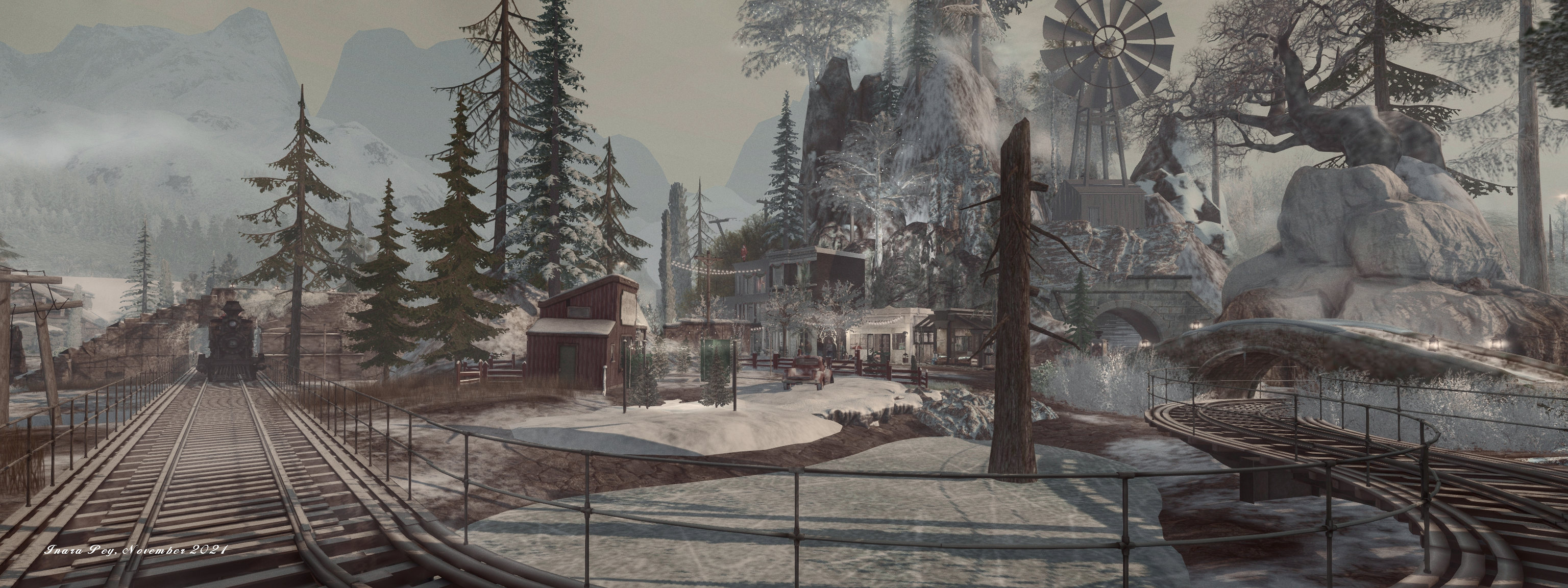
Winter Solstice, November 2021

Winter Solstice is another region that offers a mix of public spaces and private residential parcels that I recently had occasion to visit. As a Full region, it offers to the north and south – the later separated from the rest of the region by a body of water that cuts deep into the landscape, leaving the centre of the region open as a public spaces built at the foot of a tall mountain.

Held and designed by JasmineSnow (jasminesnow333), it is the home for her estate’s main rental office, but offers a lot of opportunities for photography throughout the public spaces whilst also containing a subtle nod towards Christmas through the presence of a Santa or two, whilst a number of static mannequins give further level of life to the setting.

Winter Solstice, November 2021

Most of this can be found along the region’s “main street” that runs south-to-south along the foot of the central mountain, with shops, places to grab a hot drink and even a small stables where horses can be found. Behind the street, the mountain rises, from which a single track railway track emerges to mark the edge of the water that cuts into the region to the south, before running up to the north and then back to around to re-enter the mountain, marking an informal boundary between the public spaces and the rental properties along north side of the region

There are also opportunities for activities such as ice skating an horse riding to be found within the region – again, allowing for the private residences. As well as the main street, the eastern end of the region provides plenty of open space for wandering, sitting, whilst to the west there is a music and event space.

Winter Solstice, November 2021

Beyond this, there is not a lot more to say – simply because the region, simply because it genuinely speaks for itself. It is photogenic, both thing the built-up area and in the open spaces. And with this in mind, rather than prattle on, I’ll leave you with further images and encourage you take a visit.

Winter Solstice, November 2021

SLurl Details

  • Winter Solstice (Real, rated Moderate)                                                                                        
  • Have a Great Week From All Of Us At Zoha Islands And Fruit Islands.

Will a Memory Optimizer Speed Up Your PC?

“My system seems to be getting bogged down lately, especially when I have more than one program open. And the other day I got a ‘low virtual memory’ warning. I’ve been looking into memory optimizers for Windows, but there are widely varying views as to how effective they really are. What is your opinion?” Read on for my take on memory boosters and optimizers, and why a shortage of available RAM memory might be a GOOD thing…

Are Memory Optimizers Useful?

So-called “memory optimizers” have been around for over 25 years. These programs are also called memory boosters, memory cleaners, and other names. They claim to help your computer run faster with fewer crashes by “optimizing” your system’s RAM. But do they really do anything useful? Let’s take a look at these claims…

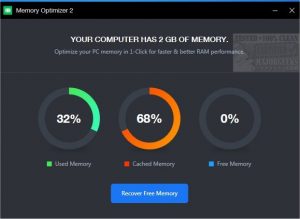
Memory optimizers claim to “free up unused RAM,” making it available for the applications and data that you are using. You can verify that a memory optimizer actually makes more RAM available. The optimizer itself will show you in its graphical user interface, or you can look at Task Manager’s Performance tab to see how much memory is available before and after running an optimizer.

More free RAM is a good thing, isn’t it? Well, actually, it isn’t, when it’s recovered by a memory optimizer. Optimizers recover RAM by forcing Windows’ memory manager to push some contents of RAM out to the page file on your hard drive.

Basically, an optimizer tells Windows that it needs lots of RAM. Windows swaps the contents of its system cache to the page file and gives the freed RAM to the optimizer. Then the optimizer releases the RAM and tells you there is more RAM available than there was before it ran.

But now the contents of the system cache are in the page file. When you need that content, Windows must read it back into RAM from the hard drive. That takes much longer than reading from RAM. The result is a significant performance hit. Supposed you are working on a Word document. You switch to your Web browser for a moment to look up something on the Web. The Word program and its data are stored in the system cache temporarily. Switching back to Word is quick because everything you need is already in RAM… unless a memory optimizer has run while you were browsing.

Defrag Your RAM With Snake Oil

Memory optimizers make other claims, like the ability to “defragment” RAM. Defragmenting hard disk space improves performance by minimizing read/write head movement. But no moving parts are used to read or write in RAM, so defragmentation does not matter at all. Optimizers also claim to shut down unused DLLs that are “stealing” RAM. But DLLs are usually shut down by Windows when the programs that use them are terminated. If a DLL remains in RAM, it is in the cache because Windows anticipates that another program will need it soon. It’s true that some poorly written programs may not free up all the RAM memory they were using when they terminate, but your operating system occasionally runs a “garbage collection” routine that finds this memory and marks it as available.

If you computer bogs down when multiple programs are open, or you’re seeing the “low virtual memory” warning, you probably need to add some physical RAM memory to your computer to make it run better.

In my opinion, memory optimizers don’t do anything useful. In fact, they usually make your system run slower! You’ll find people on the Web that swear by certain memory optimizer programs. Feel free to try them if you like, but make sure the “reviewer” isn’t the owner or an employee of the software vendor, and check the reputation of the program in other places, especially if it’s not a freebie.

I would actually argue that it’s a bad thing to have lots of free RAM memory. RAM can speed up the loading of programs, web pages, and data that’s likely to be needed again soon. It’s much faster to load a cached item from RAM than reading it from a hard drive. So if your computer reports that RAM is full, or nearly so, it may just be an indication that your operating system is doing a good job of keeping frequently needed items available for quick access. If, however, your RAM is maxed out, and you notice significant lag when loading programs or switching from one to another, you need more physical RAM, not an optimizer.

Here’s my bottom line… memory optimizers do nothing useful and can actually interfere with Windows’ memory management. If there was some super secret to freeing up more RAM in Windows, it would long ago have been built into the operating system. There is no reason to user a memory optimizer. Just let Windows manage memory for you, and install additional RAM if you really need it.

Have a Great Week From All Of Us At Zoha Islands And Fruit Islands

HAPPY THANKSGIVING!

Zuckerberg’s metaverse

Lessons from Second Life

By Joe Tidy
Cyber reporter

 
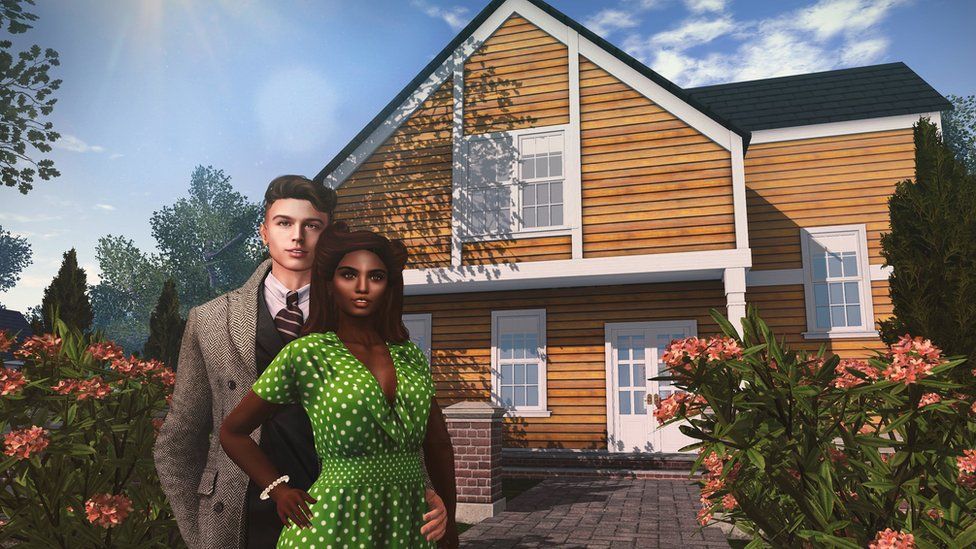
Second Life image of man and woman in a houseImage source, Linden Lab

This week, I traveled back in time to visit the future.

It has been about 10 years since I first entered the virtual world of Second Life, arguably the Internet’s first attempt at what every tech giant is now racing to build: the so-called metaverse.

The term metaverse was coined in the 1990s in a science-fiction novel, Snow Crash, where it served as a virtual-reality successor to the internet, where people live large portions of their lives in virtual environments.

Second Life peaked in the late 2000s with millions of users and hundreds of excitable headlines about people devoting hours of their daily lives to live digitally.

Since then, I assumed it had died a slow and quiet death. But how wrong I was.

The platform seems to have a small, loyal and potentially growing community of “residents”, as they call themselves, logging on to experience what our metaverse future could look like.

It is more akin to the blocky and pixelated world of Roblox than a blockbuster game built around gorgeous immersive environments.

But the difference here, of course, is that, like Mark Zuckerberg’s vision of the metaverse, Second Life is not a game. There are no gaming challenges or quests or story lines. It is just a place to hang out.

Meeting virtual Rei

One resident I met was Rei.

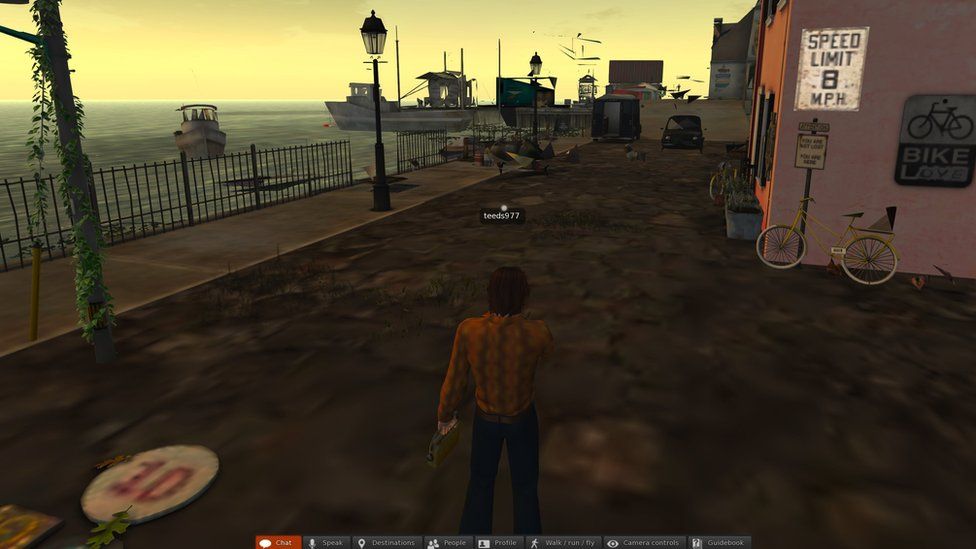
Our avatars bumped into each other after teleporting to a seaside world modeled on a strange rundown 1960s Scottish fishing village. He told me he had been spending time in Second Life for about four months after “getting curious about all this metaverse stuff”.

 
Second Life in world imageryImage source, Linden Lab
Image caption,
I met Rei in a user-built zone in Second life

Rei is not a fan of Zuckerberg’s vision of the metaverse.

“They’ll want to control everything. But I think the people should be in charge and it should be fully open,” he told me.

Mark Zuckerberg, chief executive of the newly renamed company Meta, addressed these concerns when he announced his grand plans.

“It’s a future that is beyond any one company. That will be made by all of us,” he said in his Facebook Connect keynote.

Other large corporations, including Microsoft, Epic Games, Roblox and even Nike have announced plans to enter the metaverse in some form.

Rei’s concern about a metaverse monopoly is one shared by many, including Anya Kanevsky, vice-president of product management at Linden Lab – the company running Second Life.


Anya has watched with interest as several tech giants have started to talk about the new idea of a life online. Second Life has been going since 2003.

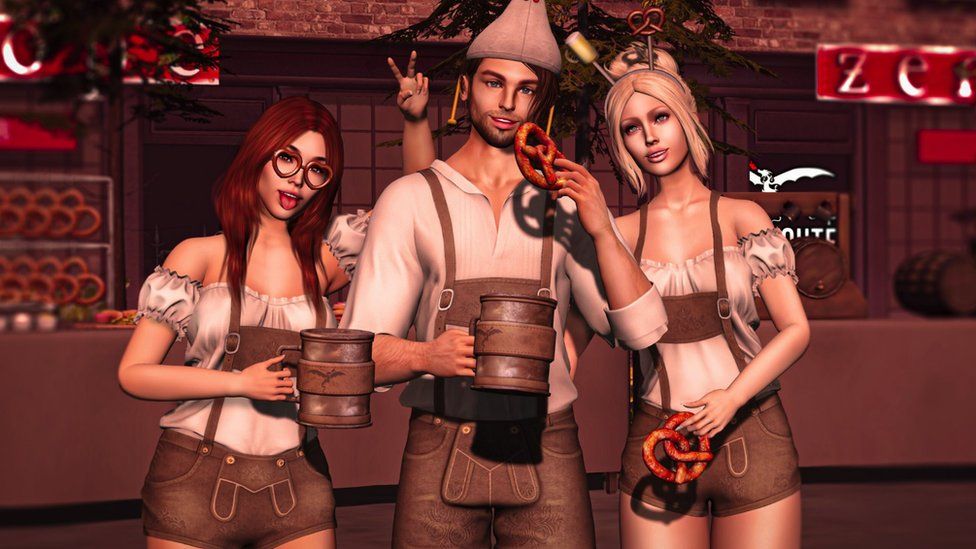
Second Life beer fest partyImage source, Linden Lab
Image caption,
Second Life residents host events

“I’m a little bit concerned about the dystopian nature that the conversation seems to be taking on right now,” she says.

“The entry of a slightly oversized and outsized player into the space seems to signal to people that they are not the owners of it, that someone else is going to be setting the rules and kind of running the show and they will just be the consumers.”

Second Life, then, is much like Roblox – a place where users build environments and invite others to play – although it has far fewer participants.

Roblox’s record for concurrent players is estimated to be around 5.5m compared with Second Life’s 90,000.

Mark Zuckerberg says he, too, wants to put a community of users at the heart of his metaverse but he does not have any residents yet.

Instead, he has pledged to take on 10,000 employees across Europe to build his worlds.

Some argue that it’s not even about allowing users more control: a metaverse should be built entirely by communities.

John Carmack, the consulting chief technology officer of Oculus, Meta’s virtual-reality headset division, believes that setting out to build a metaverse “is not actually the best way to wind up with the metaverse”.

As reported by Ars Technica, he said: “I doubt a single application will get to that level of taking over everything. I just don’t believe that one player – one company – winds up making all the right decisions for this.”

Second Life promo of man with women in seductive clothingImage source, Linden Lab
Image caption,
It’s not hard to find events and zones aimed at adult audiences in Second Life

Second Life’s story also has more lessons to teach Mr Zuckerberg and others.

At its peak, the site attracted negative headlines after high-profile virtual riots, Ponzi schemes based on the in-game currency and even issues around child grooming.

Even in my short exploration this week, I caught glimpses of the moderation challenges that Second Life faces. Those would be amplified if a metaverse went mainstream.

Searching for events or places with certain keywords such as “porn” or “drugs” is blocked.

However, searching for “sex” took me to virtual strip clubs where I was offered digital lap dances in exchange for in-world money.

“The approach to governance in a virtual world is complex,” says Ms Kanevsky.

“Some of it can be automated away but a lot of it must have the human touch. It’s not all just escapist behavior and pretty dresses and gorgeous avatars.”

Back in Second Life, I asked Rei one last question before I logged off: why does he keep coming back?

He answered: “I like to dream with my eyes”.

Have A Great Week From All Of Us At Zoha Islands and Fruits Islands.

Second Life Spotlight – Vrutega

This week we are shining a spotlight on Vrutega, a new Resident who is already creating visually striking and memorable machinima. 

Vrutega Photo Icon.png

How long have you been in Second Life and how did you first hear about it?
I have been on Second Life for a little over a year. I first found out about Second Life in 2020 through friends who are Second Life Residents. One day my friends were video streaming a Second Life party that they were hosting. I was drawn to the realism that their party showcased, from the party decor down to the house they were all gathered in. At that moment I realized Second Life is a great social platform, and has the ability to bring people from all around the world together in digital spaces. During the beginning phases of COVID-19, a lot of people lost that basic human component of socialization and connecting with people.

Second Life provided me with an opportunity to reclaim some of that human connection on a digital platform. With the help of my friends, my transition into Second Life was easy. Within a week I created my first avatar, and was up and running in no time. From the very beginning I was enamored with the Second Life world, and got involved with everything the platform had to offer from live music events, visiting art exhibits, and shopping. It wasn’t until February 2021 that I realized that I could create storytelling video content on Second Life. I studied all types of machinima video genres and artists, and became inspired by all of the talented Residents and creators around the grid.

3. Vrutega Editing Video In His Studio.png

Every aspect of the machinima you create in Second Life is very professional, from the editing to the voiceovers. Do you have a background in video production and editing?
Yes, I have a professional background in video production and editing. My experience in video production stems from my professional work in commercials, advertisements, and short films. Realism and continuity are important to me. I treat every aspect of my machinima projects like I would treat a film industry installment/project. From sourcing actors, music, props and backdrops, hashing out project logistics is very similar to the industry work I do on a weekly basis.

The benefit of working on Second Life is that I have everything a producer could need at my fingertips. With everything being digitally available on the Marketplace to inworld stores, the sourcing process is expedited considerably. And with the availability of Second Life social media, finding actors, set designers and collaborating creators has never been easier. 

3. Vrutega Editing In Premiere Pro.png

What kind of software do you use to capture and edit your videos?
I use a wide variety of post production software for my machinima projects. However I primarily edit my videos using Adobe Premiere Pro, and Adobe After Effects. I use OBS Studio to record my machinima, and capture my footage using various Second Life Viewers.

Tell us about some of the other creators in SL that inspire you, or whose work you admire.
I am inspired by a wide variety of Second Life Residents, artists and other content creators from all around the world. The person who inspires me the most in the machinima world is my dear friend and Second Life Resident Sere Vene. Sere is the artistic catalyst who pushed me to take Second Life machinima seriously. Sere’s phenomenal Second Life machinima projects made me rethink how important storytelling is, and how I should implement storytelling in each machinima I produce. Sere is a true artist, and her creativity and attention to detail knows no boundaries. I am truly honored to now work alongside her in my studio and call her my friend.

Without my small team of friends and family, there is no Vrutega. I attribute a lot of my growth and success as an artist to them. Lilith Lamia is like a mother figure to me. Lilith has industry roots in photography and cinema, and has consistently reminded me to pay attention to detail when it comes to framing and posing subjects in a scene. Spartin Parx is a creator who pushes me to think outside the box when it comes to filming a project. Just when I think I’ve perfected something in a project, Spartin often gives me that “Aha” moment that enables me to make amendments to a scene. Professional {region} builders and set designers like Agnes Whittle and Lemony Nova have inspired me to make every inch of space in a scene count. These two have helped me build the beautiful landscapes and worlds that you see in my machinimas. 

6. Vrutegas Current And Future Projects.png

What can we expect from you in the future? Are there any interesting projects you are currently working on?
I am always looking for inspiration in music, movies, television, and other pop culture references from all around the world. One of my future machinima projects will be a Pokemon-inspired video, which should excite a lot of fans of the beloved Nintendo franchise. And like all of my machinimas, this project will be done in collaboration with other Second Life Residents and content creators. 

I’m a firm believer in supporting Second Life artists and the content they create. I often find myself face to face with content creators from all types of background experiences. From seasoned video veterans to new content creators, I make it my mission to support, build and uplift those that I surround myself with. Second Life is proof that drive, determination, and raw talent can thrive in any environment when it’s nurtured.

The future of Second Life machinima is bright. Every day I see more emerging machinima creators and Second Life Residents utilizing video in their everyday lives. Machinima makers like Lipe Hax, Any Bergan, and Kelie Ladys are all promising beacons of hope and inspiration within the machinima world. Their creative machinimas have been enjoyed by thousands of Residents all over the world, and have paved the way for the next generation of machinima creators. With the introduction of independent film companies like Film Threat, Second Life is now on the threshold of bringing in film industry influences that can reshape the way we think about machinima.

4. Vrutega Social Media & Artistic Melting Pot.png

Where can people see examples of your work?
People can find my work on Flickr. I can also be found on Instagram, Facebook and Twitter.

Check out one of Vrutega’s latest videos, a carnival themed thriller that takes place in a mysterious small town. The location is Cirque du Mystere, an interactive MadPea event.

We hope you enjoyed learning about Vrutega’s experiences creating machinima in Second Life. Any budding machinima artists out there? You never know until you try!


Each of these weekly posts will feature a different Resident to showcase the spectrum of experiences and personalities found in our virtual world. If you have created something inworld that you’re proud of, or have had a deeply meaningful experience that could brighten someone else’s day, please sign up! More info here: https://second.life/spotlight-signup 

Have a Great Week From All Of Us At Zoha Islands And Fruit Islands